When we moved to our farm a couple of years ago, most of the land was what I refer to as a “big lawn”. Around 3.5 acres of grass that was probably mowed every other week with a standard riding lawnmower. When we moved in, we didn’t have a walking mower, let alone a riding mower. Our neighbors likely thought we were in for quite a task to keep such a big area mowed.
Two years later, we do have a walk-behind lawnmower that we use to mow around our buildings and garden pathways, but still no large riding lawnmower. How are we managing the majority of those 3.5 acres? The short answer is that we mostly aren’t, with mostly being the key word. Let’s discuss how we use our “big lawn” to supplement our ecological market garden!
What’s a Lawn Good For?
Initially, we didn’t really know what to do with most of our big lawn. It didn’t seem to provide any value to us, except as a place for Azula to play fetch! And we don’t have very near-term plans to grow our farm to fill out that space. So what is it good for?
Initially, the answer was pretty much nothing. We purchased a flail mower for our walking tractor that we knew we could use to keep the land from turning into a forest. So the plan was to go out a few times a year and spend the better part of the day tracing back and forth on the lawn to mow it down. To us, that’s wasted labor. Or is it?
It turns out that if you let a grass lawn grow out and then cut it, you have hay! It also turns out that hay has an abundance of uses for a biologically active farm like ours.
Fast forward to now, and we’re still taking time to mow down all that grass a few times a year. But now, we do it much more thoughtfully and consider it a productive part of the farm. We use that hay for so much!
How We Use Hay on the Farm
Hay gets two primary uses here at the farm: mulch and compost. Mulching is how we use the majority of the hay we create. Basically, we will cut a part of our field, let it dry in the sun for a day or two, then rake the cuttings and take them to specific garden beds.

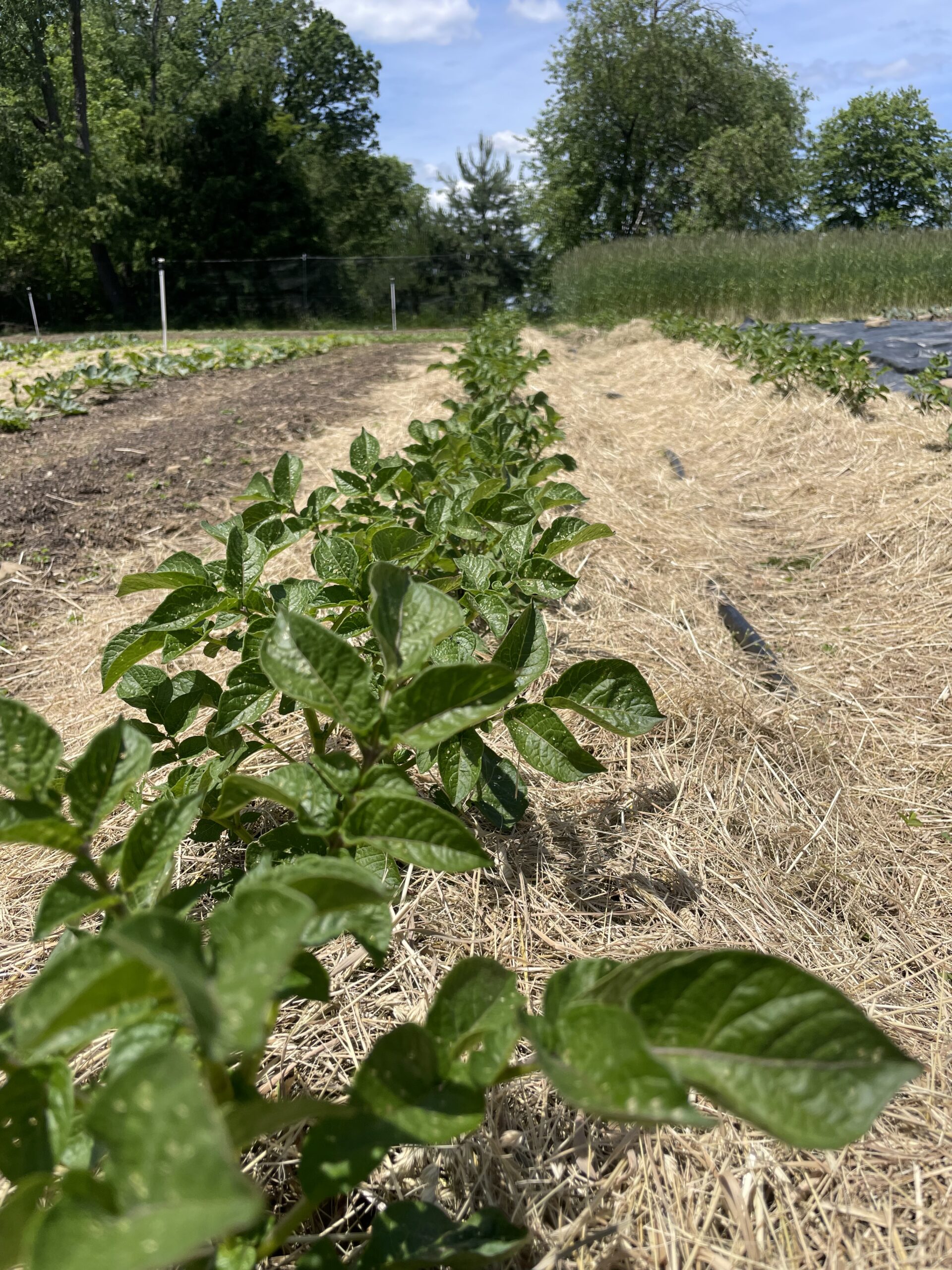
When we mulch a bed with hay, we are typically putting it on pretty thick (4-6 inches) to suppress weeds. The main crops that frequently receive hay mulch are garlic, squash, and potatoes.
Notably, for potatoes, the hay mulch serves two purposes. It not only suppresses weeds and holds moisture, but it’s also what we do in place of “hilling” potatoes. Instead of mounding soil against potato plants as they grow, we mound hay against the plants. We’ve found that on potatoes, this effect makes harvest easier. In fact, we often find potatoes completely above the soil level, sitting in the mulch!
Hay is also frequently an ingredient in our on-farm compost. Fresh hay is considered a “green” material that we will layer with things like wood chips to begin a compost pile.
How We Might Use Hay In The Future
Right now, we are only using a small portion of the hay that we produce, with the majority just being mulched back into the field. However, as our farm grows, there are more uses for hay out there!
One major use for hay is livestock. While we don’t have any plans to get large animals like goats or cows, we do have near-term plans to have a small flock of chickens. As these chickens will be pasture raised, they will use our field for forage and improve and fertilize those areas for our future use. The hay we cut is also useful for nesting and winter insulation for animals like chickens.
We will also likely expand how we use hay as a mulch on our farm. Right now, the use is fairly limited to a few crops, but there are several other crops that would do very well mulched with hay. We think we could easily double or triple the number of beds that are mulched with hay each season.