Onions are a somewhat unique crop in a small-scale market garden. They have a long growing season and spend a long time in the seedling house. Therefore, it can be tricky to make them profitable.
That being said, onions may be the most important crop to our farm. They may not be the most profitable, but their storage capacity boosts their value to us tremendously. Above all, onions are essential to cooking and eating, maybe more than any other plant we eat. Name a home-cooked meal that doesn’t begin with chopping an onion. I’ll wait!
Because this crop is so important and growing it so nuanced, we’re taking this blog post to do a start-to-finish overview of how we grow onions here at Good Dirt Farm!
How We Choose Our Onion Varieties
There are lots of onion varieties, all suited for different purposes. On our farm, we grow your basic yellow and red bulbing/storage onions, as well as shallots and green onions or scallions. This gives us the right balance of variety and reliability.
A major factor for selecting an onion variety is “day length.” Onions don’t mature like most crops, where the plant grows for a set number of days before being ready to harvest. Rather, bulbing onions decide when to stop growing green leaves and invest in a juicy bulb based on the length of day. Because the summer day length is different depending on your latitude, different onions grow best in different regions.
“Long day” onions are suited to the long hours of summer daylight in northern areas, while “short day” onions are meant for southern locations. Our farm actually sits around the 40th parallel, which is right in between. We tend to have the best luck with “intermediate day” onions. Notably, this requirement does not apply to green onions, as they don’t make a bulb.
Seeding and Early Growing
Regardless of variety, we start all of our onions from seeds, in soil blocks. In order to maximize our soil block space and make weeding and harvesting easier, we put several seeds in each soil block. Then, we transplant them all together. For bulb onions and shallots, we do 3-4 seeds per block, and for green onions, 9-11.

Germination takes 5-7 days at 70F. Onions grow slowly, and you want to get them as big as possible before transplanting. So, we budget for 10-12 weeks in soil blocks before transplant. We like to transplant in early April. That means we’re starting onions as early as January!
Onions will tolerate light and medium frosts, but too much cold may cause them to think that they survived winter and bolt. So, you want to avoid frosts as much as you can. Onions also love rich, well-fertilized soil, which we provide all of our plants at Good Dirt Farm. When transplanting, we space our bulb onions at 10-12″ per block (remember, 3-4 onions in each block) and green onions at 6″.
Growing And Care
Once onions are out, our main task is keeping their beds free of weeds. Since we are a chemical-free farm, we primarily kill weeds with a stirrup hoe. We supplment this with occasional hand-weeding. We reserve a special level of militant cultivation for our onion beds. They compete very poorly with weeds, so we demand a 100% weed free space. Seriously, if we see one blade of grass in our onion beds, we’re dropping everything to take care of it.
Onions also require steady, even irrigation, so we make sure we’ve got our irrigation on a timer and monitor it based on how rainy our weather forecast looks.
Like all crops, onions have their list of pests and diseases. Since we’ve started growing here, we’ve had minor problems with allium leaf miner and onion maggot. This means we have to be careful about giving onions a very long crop rotation. The best way to manage soil-borne disease is to ensure good drainage and high organic matter. For foliar diseases, as long as you’ve spaced out your plants properly and are weeding like a saint, you should ensure enough airflow to not let disease take over.

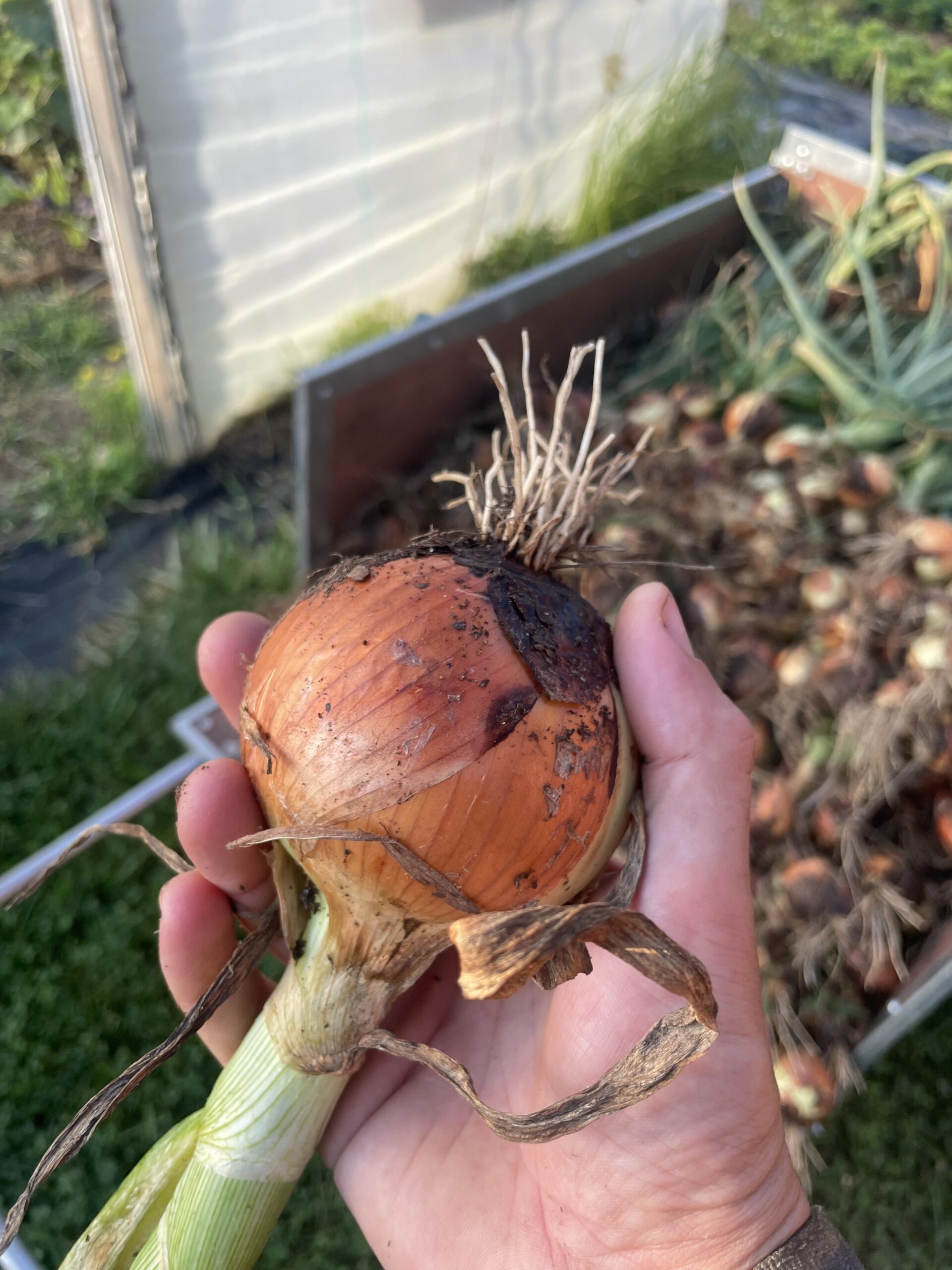
When we say that we grow 3-4 bulb onions in one soil block, folks can get confused. Don’t the onions compete with each other? Again, spacing is important! With the proper space, each onion will have enough water and nutrients. As they bulb up, the onions will push each other away easily. Occasionally, we see a flat spot on some onions, but you’d never know they were grown in a cluster.
How We Harvest & Cure Our Onions
For bulb onions, harvest can occur at any time after the bulbs have swelled. However, most farmers wait until the green tops naturally fall over. I’ll note that neck diseases can occur if it is very wet and humid around harvest time, so many growers harvest early to avoid diseases like this.
For us, storage bulbs are ready for harvest throughout July and into early August. We grow green onions in successions, so we harvest several bunches each week from May through October. Having green onions pre-bunched in soil blocks makes harvest easy. We just pull the whole bunch and put a rubber band around it!
Bulb harvest involves more steps. After pulling the bulbs from the soil, we will let them sit in the sun for a few hours (if it’s a sunny day). Then, we take them into one of our high tunnels and our seedling nursery. We will actually reserve a bed or two of precious high tunnel space for drying onions. The whole plants are spread out to dry for around 2 weeks, or until the necks are completely closed and dry where they meet the bulb.

Storing Onions
When the bulbs are dry, we pinch off the neck and roots, and gently brush away any dirt or extra flaky paper. We aren’t fully “cleaning” onions at this phase, as more layers protect the bulbs better. The onions are then moved to a cool and dry space, with emphasis on ensuring low humidity. A cold room where you store your weekly greens harvest, for instance, will be too humid.
We store our onions in our basement, which holds temperatures in the high 50s and relatively low humidity. While these conditions aren’t ideal, we typically have excellent storage quality through the end of December. Usually, our yellow storage variety is still storing well into March and sometimes April!
We sell our bulb onions in quart bins that are roughly 2lbs, from July right through to when we run out. And of course, our CSA members get onions in their shares fairly often! Our goal is to have abundant onions until at least mid-December, when our fall CSA ends. It is a bonus if we have more past that, for both ourselves and to sell to restaurant customers in the winter.