
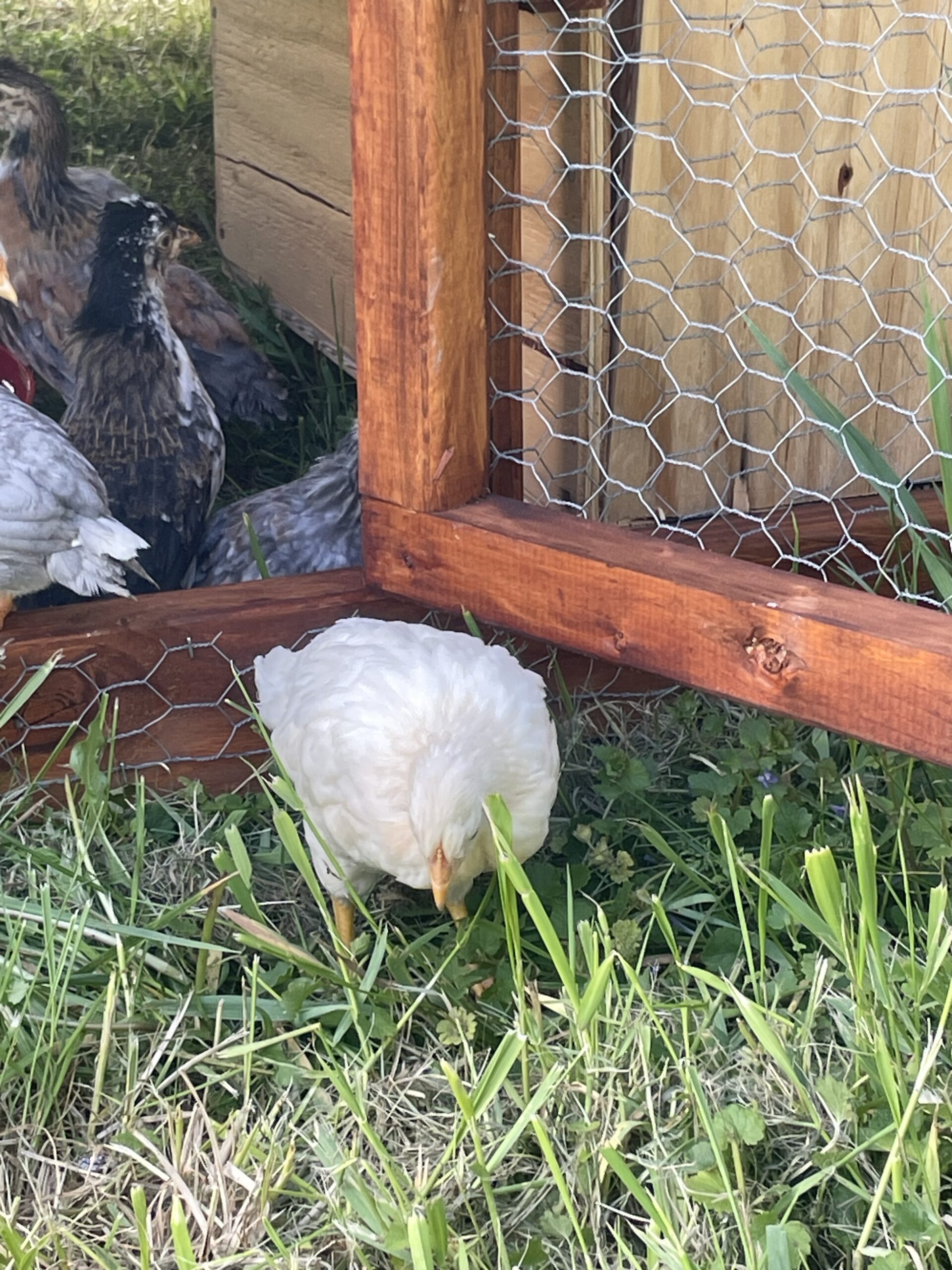
This year, one of our biggest new additions to the farm is a flock of chickens that we hope will provide our community with eggs and ourselves with a little bit of meat. The chickens started their journey in a cardboard box in our basement, but this week it was time to let them outside.
Our chickens will be outside year-round, taking advantage of all of the benefits of pasture. We’ll give you an overview of how we’ll be managing them outdoors!
Protection Is Key
To raise chickens well, you need to think about protecting them, both from the elements and from predators. There are several key pieces of infrastructure and equipment we have to do so.
First is our mobile chicken shelter, which we discussed in one of our previous blog posts. This little A-frame gives the flock protection from rain, snow, wind, and hot sun. It also allows the chickens a place to lay eggs, eat and drink, and dust bathe, all in a self-contained unit.
The A-frame is simply too small to be a full-time abode for our flock. We like to think of it more as a bedroom for the chickens, somewhere they can safely sleep or take shelter in. Chickens are naturally inclined to spend their days outside, scratching and pecking in search of natural foods. We want our chickens to spend their day freely roaming about, but obviously, we want to keep them close and protected.
This is where our electric net fence comes into play. It’s a woven fiberglass fence that has wires integrated to electrify it. Ours has a little solar battery that we mount on one corner, electrifying the whole thing. It gives us around a 40-foot square of pasture for our flock.

The fence has lots of benefits for our system. Because it is a mesh design, the chickens can’t walk out. The electrification keeps out any and all ground-based predators. The most beneficial aspect of the fence is that it is movable! The posts are simply staked into the ground, and so far, it has taken us around 20 minutes to completely move the fence.

These two elements offer all the protection our flock needs while maintaining lots of space for them. They also allow us to move their location whenever we want, which is key to our system.
The Importance Of Rotation
Keeping chickens outside is great, but keeping them in the same spot has problems. Chickens love to scratch and dig, and eventually they will take a lawn and turn it into a mud pit. Thus, keeping pastured chickens in the same location ultimately destroys the pasture itself, obviously an unsustainable practice.
The ideal situation is that chickens have time to explore a pasture, feed on the local flora and fauna, and then move on. Instead of degrading the pasture, this ultimately improves it! Seeds are dispersed, the soil layers are aerated, and the chickens drop their “fertility” all over the place, enriching the pasture.
Pastures that have chickens run over them properly will bounce back better than they were before. If given a few weeks to a couple months to recover, they will once again be ready for the chickens to be let loose upon them. This is where a “rotation” comes into play.
Basically, we’ve set up 8 squares in one of our fields. When the chickens have exhausted one section, we will move the fence and their shelter to the next, fresh section. So on and so forth! This rotation both manages the chickens and the pasture in perfect symbiosis!
Benefits Of Pastured Poultry
Why go through all of this trouble? Most industrial chicken farms are simply warehouses filled to the brim with chickens who may never see the sun their entire lives. Even “free range” labeled products come from chickens that spend 99.9% of their time indoors, packed too closely with others.
We don’t believe that’s how animals should live their lives. We know that chickens originated as a jungle bird, and they are inclined to be outside searching for plants and bugs to eat. Fresh air, sunlight, and exercise produce birds that are supremely healthy and happy.

It should be no surprise that happy, healthy birds result in the best eggs and meat. The highly diverse, nutrient-packed diet of a pastured chicken gets passed along to us! Pastured eggs and meat have more nutrients and simply taste better, too.
Raising chickens on pasture may take more planning and effort, but the benefits to the chickens, our soil, and our bodies cannot be denied!